Jon Klassen's Acceptance Speech
Watch and read Jon Klassen's acceptance speech from the Astrid Lindgren Memorial Award Ceremony on 25 May, 2026.
Good evening,
The clearest place to start here is to try and express my thanks. My thanks first to the jury members for their work both in the consideration of my books, but also for the time they gave to everyone who was considered and put forward. There is so much exciting work being made in this field. I feel honored to be making things at the same time as my colleagues. I learn so much from what they make, and I steal from it often. We all steal from each other, it’s ok. At least I think they are stealing too. I hope I’m not the only one stealing. Also to everyone who put my name forward in the first place, to be on that list of amazing nominees was itself a great honor. I will spend as much time as possible going forward trying to express what this award means to me. It is truly life-changing.
The list of people to thank is long. This is a career-award, after all, and any career is a team effort.
- my editors
- my art directors (particularly Ann Stott, who is here tonight)
- my publishers both at home and internationally. To those of you here tonight, if I have trouble looking straight at you it is because I’m overwhelmed by your support.
- the authors whose work I have gotten to illustrate, particularly my old friend Mac Barnett
- my friend and agent and sword and shield Steve Malk
- the parents and the teachers and librarians and booksellers who have shown my work to its audience. You are a fickle bunch and I know you are not easily won over, and your support has meant everything to me. Please keep doing what you are doing for anyone, anyone, who you think is doing good work. I am here to tell you its effect is real and immeasurable.
Finally, my family. My parents and my brothers, who never thought this was a weird job, and have always been so supportive. And my wife Moranne and my kids, Isaac and August, who are here tonight. I’m so proud to be with you guys. Everything is for you.
I feel incredibly moved at having been chosen for this distinction. I am moved by the existence of the award at all. The value that is put on this kind of work by the committee, the staff, and everyone who contributes to it, is unmatched in the rest of the world. Coming to an environment and a country where children’s literature is seen as being worthy of a prize of this weight, much less being given that award, is encouraging to a degree that is difficult to explain.
The honor is so great that I find myself consciously working on how to stand in relation to it. What attitude should I take in its reception?
On the one hand it can scare you a little. An award given to your collected work is a statement on yourself that one doesn’t normally get, and anything that definitive, even in a positive way, I tend to regard with a little suspicion. I know what my drafts look like. I know what my desk looks like. If they could see those things they would take this award away immediately.
On the other hand, you want to take it graciously, maybe even proudly. Maybe the work is good. Maybe I am smart. Maybe this work is important. Maybe it is the most important.
Toggling between thinking you are the worst to ever attempt it, and that it is meaningless anyway, and suspecting that maybe this will be the best book that has ever existed, and it's going to save us all is kind of how anything like this gets made, it seems. We are built on contradiction.
Children, at least a lot of the ones I meet, are particularly comfortable with contradiction. They are not afraid of it. It does not threaten them the way it threatens a lot of older people. This is maybe because we are handing them contradictions to hold all the time. We are telling them one day that the world is wonderful but on other days we are telling them it is full of horrors and that they must watch every step they make out there. We are telling them that the earth is vast but also a speck in the universe. We are telling them that we, their elders, are strong and wise, but any amount of time spent with us reveals fear and weakness. But all of it is true. And it should all be allowed to be true. We should be able to say “The world is wonderful and terrible.” “The earth is vast and a speck.” “We are strong and we are weak and in need of help.”
Sometimes the whole point of a picture book can be to establish a contradiction and simply let it stand. Maurice Sendak won this award many years ago. In “Where The Wild Things Are” a boy is sent to bed without dinner by his exasperated mother. A forest and a sea grows in his room and the boy sails away on a boat for weeks and arrives at an island full of monsters and stays there until he finally misses home and sails back again, and finds, upon re-entering his room, that his mother has left him some dinner after all, and it is still hot. But, in the illustration, the moon in the window has changed phases very clearly. Time has passed. Maybe a lot of time. It all really happened and of course it didn’t. Near the end of his life, Sendak gave an interview and he was asked if his well-known atheism felt shaky now that he could feel his death was so near. “I don’t believe in an afterlife,” he said. “But I still fully expect to see my brother again.” Sendak seemed to know that not only are we naturally full of contradiction, it is sometimes the main thing holding us up at all.
Picture books are excellent vehicles for contradiction. The pictures can say one thing, and the words might say another. The truth is found somewhere in the middle. Picture books are, or can be, a way of acknowledging the shortcomings of what we know, or are able to say clearly in either medium. It can be a way to point out the limits of language to an audience who has only recently been introduced to the concept, and is still naturally (and wisely) skeptical of it. What this can all lead to is books that don’t always explain themselves, at least not explicitly. Children largely seem ok with this. Adults can be less receptive. Adults often want to know what it is you are saying in your book. What is the message. What do you mean.
The Canadian poet Leonard Cohen once read one of his poems on the radio. It took several minutes. When he was finished the radio host asked him what the poem meant. Leonard paused a moment, and then just read the entire poem again. This is not because he had a secret explanation he was holding for himself. The story, or the poem, or the song, is meant to use its time to establish multiple points in space, and whatever it is you as the author are looking to communicate or confirm is somewhere inside this newly established perimeter.
If someone who doesn’t spend their time in children’s books stumbled in here tonight and was listening to this speech for some clarification as to who I was or what this work was for, so far what they would have is that I’m full of contradictions and that the point of the work cannot, maybe should not, actually be named.
So what are we doing? What is this work for? What is it worth? Why do we value it, or spend time on it?
The author George Saunders made a book about writing and analyzing Russian short stories entitled “A Swim In A Pond In The Rain”. Near the end of the book, Saunders winds the book down with a section on writing fiction generally. If you play a game in this passage where you replace the word “fiction” with “children’s literature”, it still works pretty well. I thought I would read a slightly edited version of this section for you tonight.
Mister Saunders begins:
"The writer and the reader stand at either end of a pond. The writer drops a pebble in and the ripples reach the reader. The writer stands there, imagining the way the reader is receiving those ripples, by way of deciding which pebble to drop in next.
Meanwhile the reader receives those ripples, and, somehow, they speak to her.
In other words, they're in connection.
These days, it's easy to feel that we've fallen out of connection with one another and with the earth and with reason and with love. I mean: we have. But to read, to write, is to say that we still believe in, at least, the possibility of connection. When reading and writing, we feel connection happening (or not).
Those two people, in those two postures, across that pond, are doing essential work. This is not a hobby, pastime or indulgence. By their mutual belief in connection, they're making the world better, by making it (at least, between the two of them, in that small moment) more friendly. We might even say they're preparing for future disaster; when disaster comes, they'll enter it with a less panicky, reactive version of the Other, because they've spent so much time in connection with an imaginary other, while reading or writing."
Mister Saunders continues:
"There's a certain way of talking about stories that treats them as a kind of salvation, the answer to every problem; they are "what we live by" and so on. And, to an extent, I agree. But I also believe, especially as I get older, that we should keep our expectations humble. We shouldn't overestimate or unduly glorify what fiction does. And actually, we should be wary of insisting that it do anything in particular. The critic Dave Hickey has written about this, the notion that saying what art should do might enable a reactionary establishment to start saying what it must do, and then to begin silencing those artists whose works aren't doing that. In other words, whenever we get up on the soapbox to sing fiction's praises, explaining how good it is for everyone, we're actually limiting its freedom to be… whatever it wants to be.
And let's be even more honest: those of us who read and write do it because we love it and because doing it makes us feel more alive and we would likely keep doing it if it could be demonstrated that its overall net effect was zero, and I for one, have a feeling that I would keep doing it if it could be demonstrated that its overall net effect was negative."
Endquote, and I’m not sure I can follow Mr. Saunders down that last point. If it turned out children’s books actively hurt people I would probably learn how to make chairs or something.
So. Children’s literature might save us all from certain disaster and we should keep our expectations small. Picture books and their audience are capable of holding sophistication, mystery and nuance and I once spent the better part of a year figuring out how to get two turtles to share one hat.
I am up on a stage giving a speech that is running a little long, with my face on the front of this building and I am deeply humbled by your support and this award and promising to try to keep make you proud, and serve this art form as best as I can.
Thank you so so much.
Award ceremony 2026
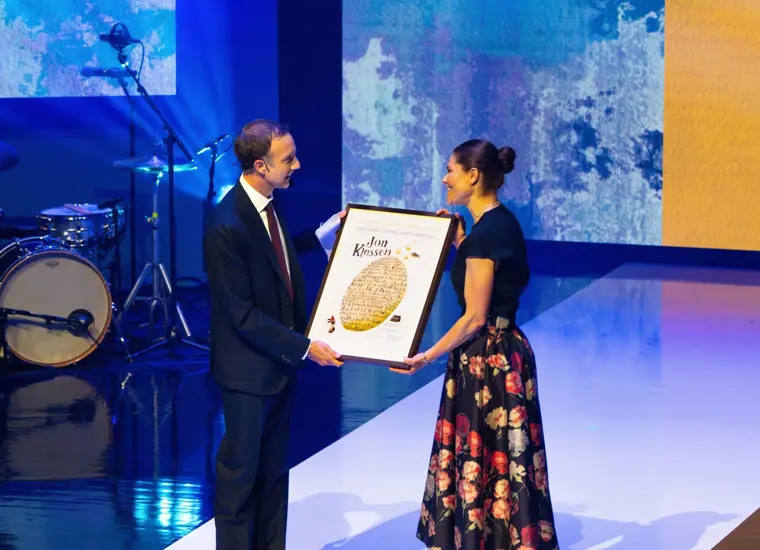
During a grand evening at the Stockholm Concert Hall on May 25, we celebrated the 2026 Astrid Lindgren Memorial Award Laureate, Jon Klassen. The award was presented by Her Royal Highness Crown Princess Victoria of Sweden.
See the highlights from the award ceremony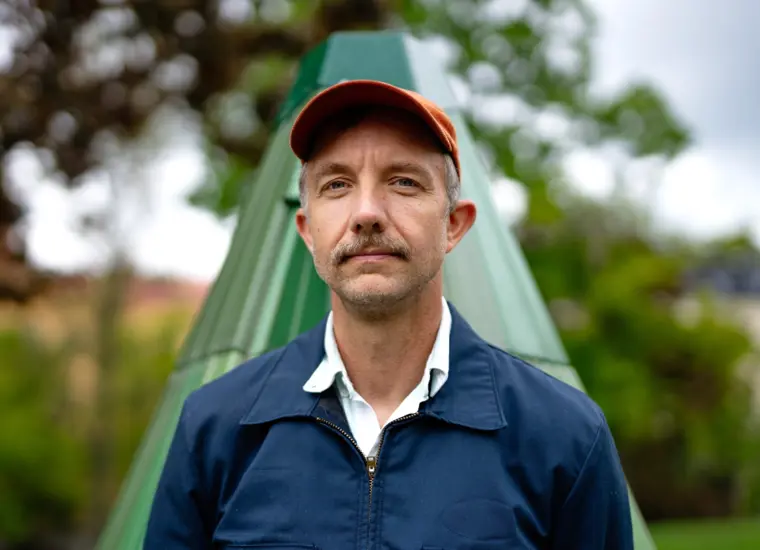
Precision, emotion and inventive wit
Jon Klassen is a Canadian illustrator and picture book artist. His breakout book "I Want My Hat Back" (2011) is a layered, ingeniously told tale of ownership and morality. Klassen's body of work forms a subtle, astute, and humorous investigation into existential questions, where feelings of anticipation, suspense, and shock play a central role.
Discover Jon Klassen