 Photo: Maja Brand
"I'm just not comfortable without a hat"
What does Jon Klassen’s creative process look like? What does his selection for the Astrid Lindgren Memorial Award mean to him, and where does his obsession with hats come from? We called the 2026 laureate to find out!
When you received the phone call from the jury, you had just dropped your kids off at school and were running up a hill. What went through your mind when you realised it was the chairperson of the Astrid Lindgren Memorial Award on the other end of the line?
– It was a slow process, the realization. It was just deeply unexpected. Winning an award like this is so far from your mind that putting it back into your mind takes a minute. I think I was just speechless and I felt so bad because this is the call that the jury’s looking forward to making, and there I am just staring at a tree in my yard. But then I thought of all the previous laureates, people whose work I admire so much, and how proud I was to be on the list with them.
What did the rest of your day look like?
– It was an interesting back and forth between trying to get your head around it and getting a text from a friend or a colleague saying congratulations. It was so strange to be in your house but then seeing pictures from the Bologna Children’s Book Fair with the big billboard and your face is on it, but you're still sitting with your cat having coffee and you're like: “Maybe it didn't happen?” And then someone else will send you a message and you’re like: “Oh, no, it did really happen!”
I'm kind of bad at sketching. I never really learned how to do four sketches and then say goodbye to the other three once the one was chosen. It's kind of heartbreaking.
Tell us about your creative process. Do you plan the whole story before you begin, or do you just sit down with a blank paper?
– I like to have a plan. I'm a nervous creative person, I don't feel very free and easy with the tools, and I think that I've sort of learned to use that anxiousness in the tone of the work. I'm also kind of bad at sketching. I never really learned how to do four sketches and then say goodbye to the other three once the one was chosen. It's kind of heartbreaking. So I try to make the writing and the illustrating depend on each other so that I can't move anything after that. But my favorite work comes when I let go of that a little bit. For instance, if I find that I'm stuck, with the writing especially, I should usually take something away. Something that I thought was necessary when I was planning it.
Speaking of that, in your picture books you often leave a lot open to interpretation. Instead of showing an actual event, you suggest what might happen or what might have happened. Why is that?
– I was a really sensitive reader when I was little, and I'm still a sensitive reader. And viewer as well. There's just so much I can take when people are going through something horrible on film and you get to watch them feel it. I just can't bear to do it to my guys, I can't ask them to feel that way. Instead, I say: “Don't worry, we're going to turn the page and all the bad stuff is going to happen between the page turns”.
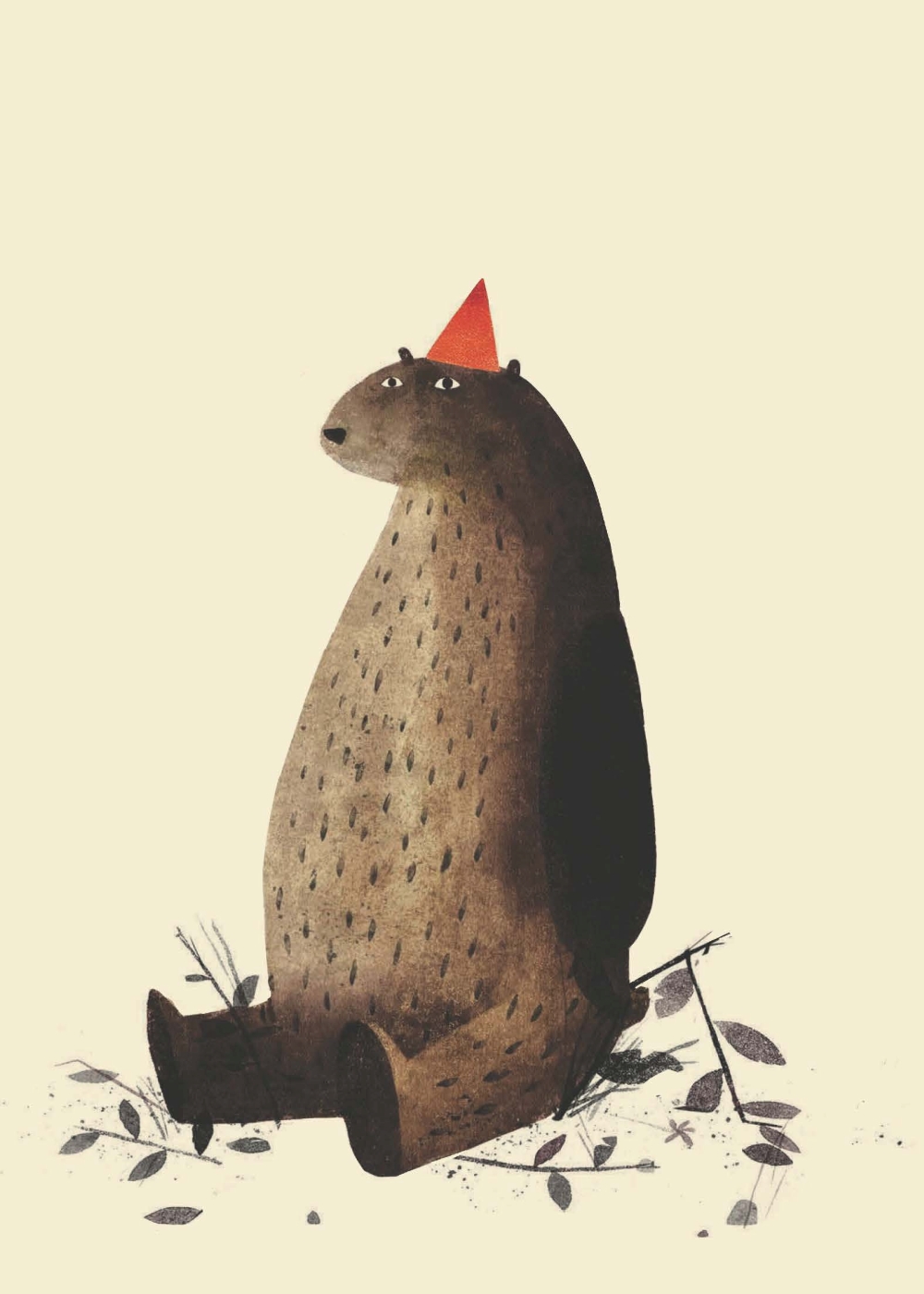 I WANT MY HAT BACK. Copyright © 2011 by Jon Klassen. Reproduced by permission of the publisher, Candlewick Press, Somerville, MA.
What tools and materials do you use when creating your illustrations?
– I use ink a lot. For all of the hat books I used black and white Chinese ink. I just liked what it does on the paper, how it leaves a little bit of dirt behind. I went to school for animation and I never really learned how to be a very ambitious painter were you’re mixing colors and rendering in their shadows and all of that stuff. So for me, ink behave very well. For the third hat book (We Found a Hat), I also used powdered graphite. It’s sort of like a black powder that you mix up with water and when it dries it gets this sandy texture. The book was meant to take place in the desert, in the dirt, so to help myself out a little bit I used a dirty medium.
Do you do any digital editing?
– Yes, I use digital media as sort of a dark room for the work. If I wish that the ink had gotten a little darker in a corner, I go in there digitally and punch it up a little bit. I also do all the sketches digitally. If I did actual paintings for the roughs, I would be kind of bored with it, whereas with digital, I don't fall in love with the images at all. They're kind of ugly when you print them, but they get the job done.
As you said, you studied animation and you used to work at a big animation studio. What made you take the step into the world of children’s books?
– I started out as a storyboard artist and my job was to draw out what was going to be on the screen at any given time, and to kind of control the camera related to the to the action and the characters. And so often, when there was a conflict or an explosion, or whatever it would be, I would want to move the camera away so that you could just hear the sound of the explosion. But huge animation studios with huge budgets, like the one I was working at, they’re not necessarily interested in too much omission. They want to show everything. And since I’m very sensitive, I thought that maybe I'm just not built for this kind of job. But then I got into picture books and right away I recognized that all these things that I thought were weaknesses of mine suited this medium. I felt that I belonged here.
You’ve written three books about hats, and it’s almost impossible to find a photo of you where you’re not wearing one. Where does this obsession with headwear come from?
– Haha! That’s pretty funny. I mean, it can't be a coincidence that I started making books about hats when I wear them all the time… I've worn them since middle elementary school. Every day, all the time. I'm just not comfortable without one. But I think I have different reasons for them narratively than I do for wearing them. In the stories, they were just very graphically useful. Especially in the first book with the bear (I Want My Hat Back). Once you've told the audience that a character in your story wants to be wearing a hat but isn't, that story better end with that character wearing a hat!
Listen to Jon Klassen share more about his relationship with hats:
We also have to talk about eyes. Your characters often have very distinctive eyes, but in your recent board book series, even non-living objects—like the truck, the house, the furniture, the river—have eyes. How did that come about?
– What I’ve realized, with the board books especially, is that the eyes are doing a lot of talking that I’m not able to do. I don't know how to write what a character might be going through internally. I don't really want to try either. It's kind of their business, not mine. But the eyes can suggest what they might be thinking. Is the sun and the tree happy about this situation? Does the tree want to go over to the sun? Will they get along? Those questions aren't answered, but you as a viewer, as a child, looking at the pictures, are involved in their thoughts.
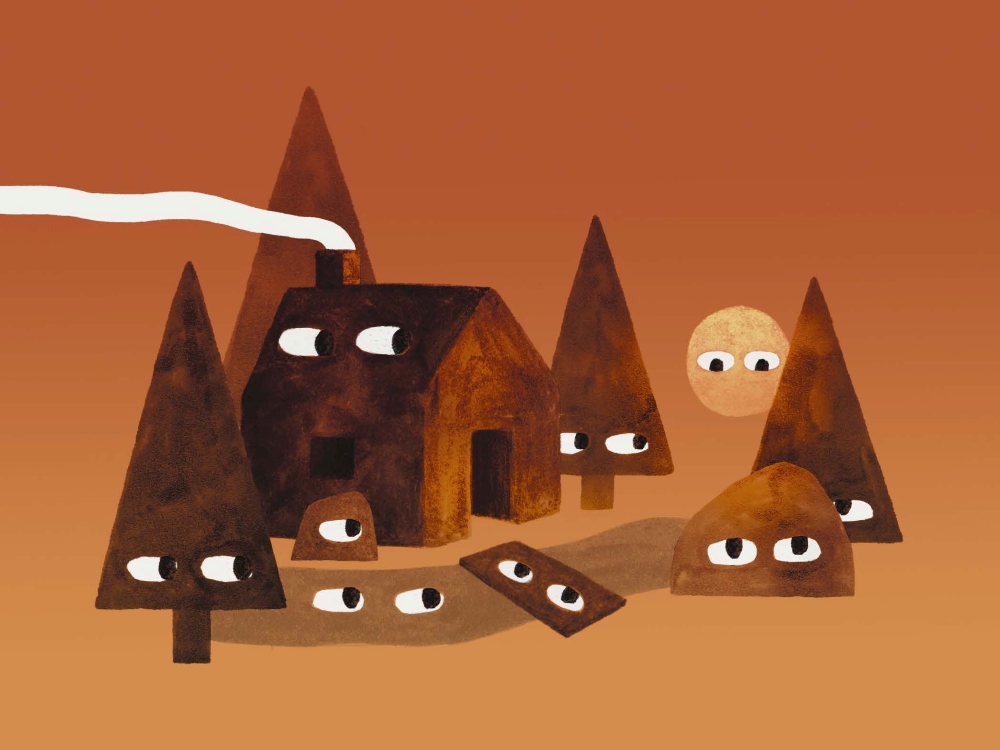 YOUR FOREST. Copyright © 2025 by Jon Klassen. Reproduced by permission of the publisher, Candlewick Press, Somerville, MA.
Another thing with your characters is that they often lie. They say that they didn’t do this or that when it’s quite obvious for the reader that they did.
– Yeah. It goes to my interest in language for kids, I think. They are pretty new to language when you meet them with these books and their relationship to language is still so suspicious, and rightfully so. As soon as they discover that they can say things that aren't true, they do it all day. It seems like an amazing discovery and I'm super interested in that as a phenomenon. But I don’t like to say “You shouldn't lie”. They know that already. I just show them that when you lie, this is what it looks like and I leave it there. I think it's rare that they get a chance to just acknowledge that they lie without the extra admonishment.
In the jury’s citation, they say your books “open new perspectives on our place in the universe.” Would you describe yourself as a philosophical person?
– I suppose so. I’m thinking a lot about questions like; How are you supposed to act in this situation? How shall you be? What is this all? What does it mean? But I’m not settled in any of my answers to these things, so the books have become a great way for me to ask these questions.
This award comes at a moment where I feel the most personal in my work and the validation to that, to say that it is broadly understood and appreciated, it's hugely meaningful and really humbling.
Apart from the philosophical side, your books are often praised for their humour and wit. What does humour mean to you?
– Humour is how I like to establish communication. Most of the time it’s hard to know if you reach people, but if they laugh and your intention was to make them laugh, then you did it. It’s the best proof that you were able to communicate.
– In The Skull in particular, which deals with some really heavy stuff and can be a very scary book, the humour was also used to make the audience feel a little safer in the story. If I can make them laugh, it means they can trust me to a certain extent. I'm not going to drag them into a corner of the story that's going to do them harm.
Which is harder: writing and illustrating books yourself, or illustrating for other writers?
– I think writing and illustrating is harder. I feel much more relaxed when I illustrate for others because I’m not inside my head so much. Someone else has started you off. I also have to say that it’s a huge honour to illustrate someone else's work. The strength that it takes from authors to trust their illustrators, it’s so admirable.
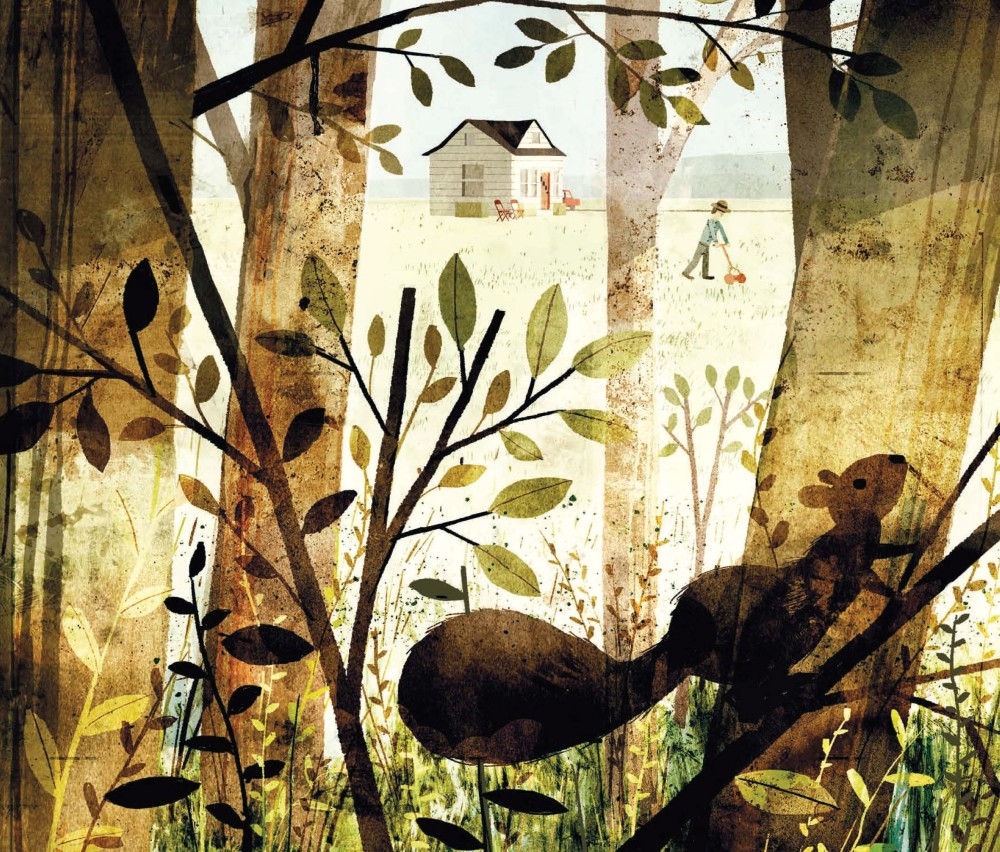 HOUSE HELD UP BY TREES, written by Ted Kooser and illustrated by Jon Klassen. Illustrations copyright © 2012 by Jon Klassen. Reproduced by permission of the publisher, Candlewick Press, Somerville, MA.
You’ve received many awards and honours throughout your career. What does the Astrid Lindgren Memorial Award mean to you?
– I’m very, very moved by it. To be connected to Astrid Lindgren and what she stood for, her belief in children and her belief in humanism. I’m also really happily shocked that the jury has been considering my later board books, which are quieter stuff but very important to me. This award comes at a moment where I feel the most personal in my work and the validation to that, to say that it is broadly understood and appreciated, it's hugely meaningful and really humbling. And then again, the list of previous winners… It's people that I just admire hugely, who are so big in my mind and creatively such heroes. I'm still coming to terms with that part.
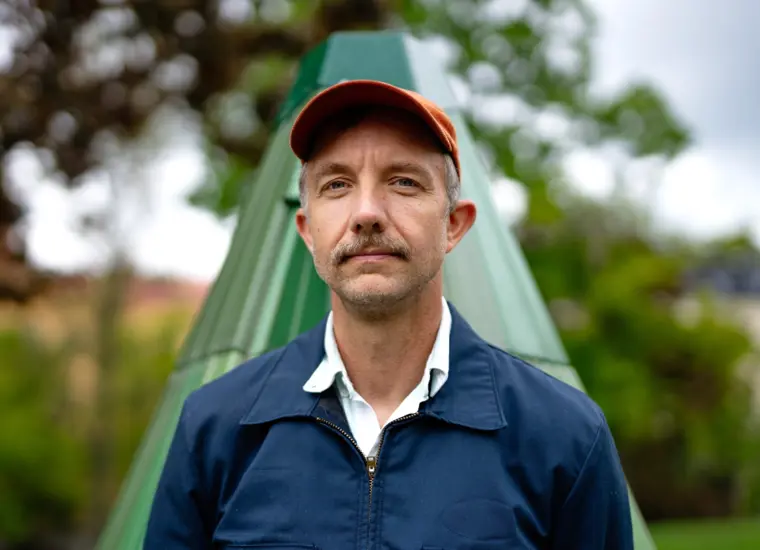
Precision, emotion and inventive wit
Jon Klassen is a Canadian illustrator and picture book artist. His breakout book "I Want My Hat Back" (2011) is a layered, ingeniously told tale of ownership and morality. Klassen's body of work forms a subtle, astute, and humorous investigation into existential questions, where feelings of anticipation, suspense, and shock play a central role.
Discover Jon Klassen
Children have the right to great stories
To lose yourself in a story is to find yourself in the grip of an irresistible power. A power that provokes thought, unlocks language and allows the imagination to roam free. The Astrid Lindgren Memorial Award was created in 2002 by the Swedish government to promote every child’s right to great stories.
